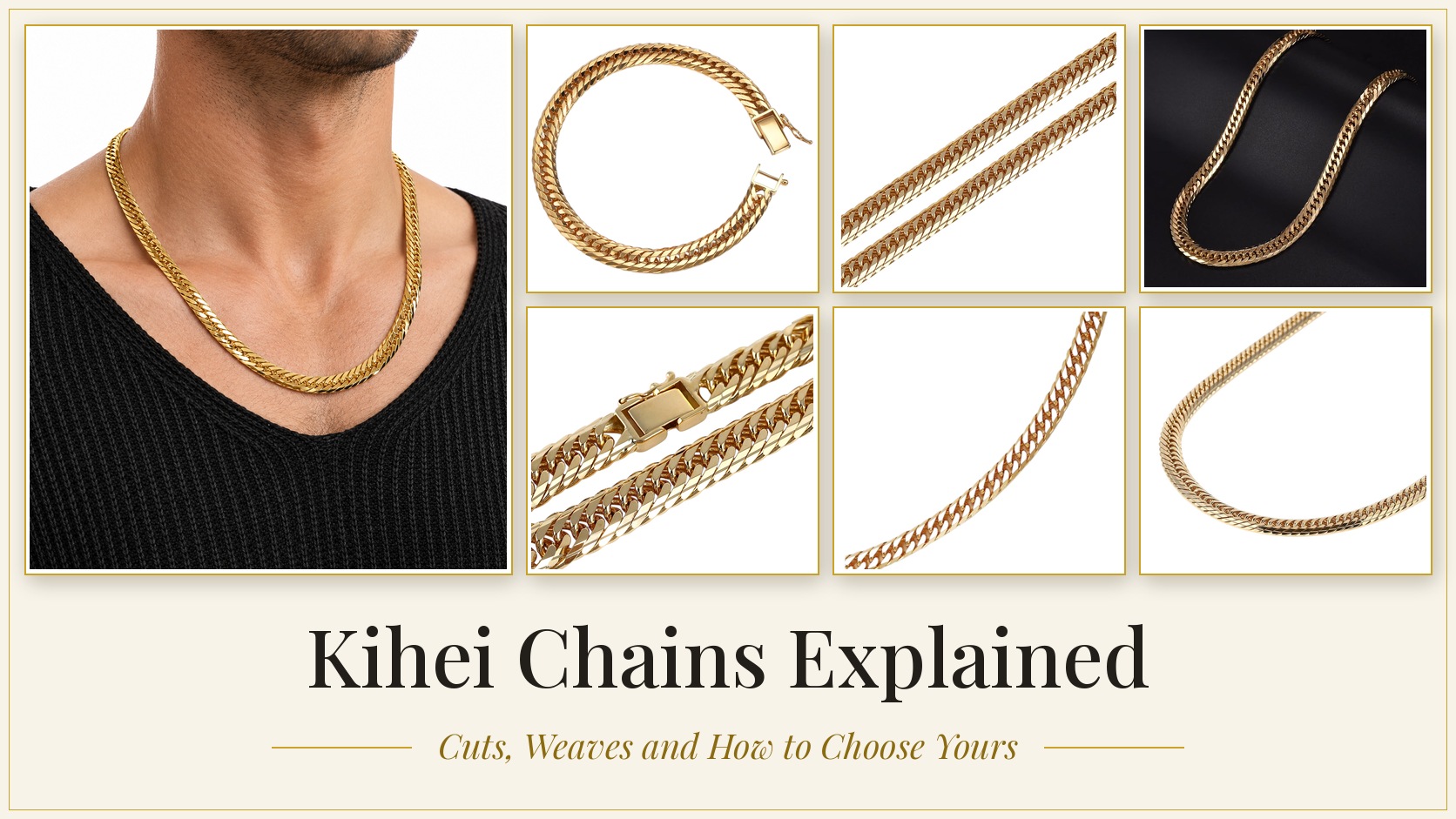
If you have ever looked at one of our Kihei listings, you have seen a name like this: "Necklace K18 10g 6 Sided Double 6 Cut Kihei 40cm."
It reads like a code. It is really a short description, and once you know the words, you can picture the chain before you open the photos.
This is the question we answer most often about Kihei, so here it is in one place.
What Is a Kihei Chain?
A Kihei (喜平) is a flat-link chain. Each link is twisted and then pressed flat, so every link faces the same way.
That is why a Kihei lies smooth against the skin and shows one continuous line of shine along the front. It is used for necklaces and bracelets.
The style is said to have European roots, and it became widely loved in Japan during the years of rapid economic growth. Nobody is sure where the name comes from. One story credits a Japanese craftsman, and another the decorative chains once worn by cavalry horses. Today, Kihei is the name used in Japan for this whole family of chains.
The Cut: How Many Faces Catch the Light
The "cut" is the number of flat faces on each link. More faces mean more small surfaces catching the light.
- 2-cut has the fewest faces and the simplest look.
- 4-cut, 6-cut and 8-cut add more faces to each link.
- 12-cut is finer again. You will see it on our triple bracelets.
- 20-cut has the most faces of all.
You will also see "M-Cut" and "16 Sided" on some of our listings. We use the maker's own words for those pieces, so please look closely at the photos of that piece, and ask us if you want a closer look.
Use the cut as a guide, and let the photos of the piece confirm it.
The Weave: Single, Double or Triple
The weave is how many links pass through each link.
- Single is one link through the next.
- Double, also written "W Kihei", links the rings in pairs, so the chain is denser.
- Triple links them in threes, so it is denser again.
Put the two words together and the name starts to make sense. A "6-cut double" has six faces on each link and a double weave. A "12-cut triple" has more faces and a denser weave.
The Weight: Why Grams Are in the Name
Every Kihei we list carries its gram weight in the name. For a gold chain, weight tells you a great deal: how substantial it feels, how wide it looks, and how much gold you are holding.
Our Kihei pieces are K18 gold, which means 75% of that weight is pure gold. The rest is the alloy that makes the chain hard enough to wear every day. K18 is the most popular choice for a Kihei: it keeps its golden colour, and it resists tarnish.
If you would like to understand the K18 stamp itself, our K18 Gold Guide explains it step by step.
Reading Our Listings
Here is how the words look on pieces from our Kihei collection:
- N0640 Necklace, 10g, 6-cut double, 40cm. A light necklace with a bright, solid look.
- B1850, B1747 and B1645 Bracelets, 12-cut triple. Fine 0.5mm links, between 4.5g and 5g, in 16cm, 17cm and 18cm.
- N1616 Necklace and B1628 Bracelet, M-Cut 16 Sided triple. A dense triple weave, in a 16.65g necklace and a 28.98g bracelet.
- 8C100 Necklace, 100g, 8-cut, 50cm. The statement piece.
Same family of chain, very different presence. You can see them all in our Kihei collection.
How to Choose Yours
Start with how you want to wear it.
- For every day: a lighter weight with a 6-cut double or a fine triple sits comfortably and goes with everything.
- For presence: more grams and a longer length. This is the chain people notice.
- For a gift: a Kihei is often given at life's milestones, such as a coming-of-age, a new job or a wedding anniversary. A bracelet is a lovely choice. Our Jewelry Guide explains sizes and lengths.
If you are deciding between two pieces, send us a message. We will help you compare them.
Caring for Your Kihei
A little care keeps the flat faces bright.
- Wipe it with a soft cloth after wearing, to remove sweat and skin oils.
- Store it in its case, away from other pieces, so the faces do not get scratched.
- When it needs more, clean it with warm water and a mild soap.
- Keep it away from hot springs, seawater and chlorine, which can discolour the metal.
Still Not Sure? Ask Us
The words on a listing are there to help you, not to test you. If any of them is unclear, message us with the piece you are looking at, and we will explain exactly what you would be getting.
Comments0 comments
Comments appear once our team has checked them.
No comments yet.
Sign in to comment