K18 is gold that is 18 parts in 24 — 75% gold — with the remaining 25% an alloy of metals such as silver, copper and palladium that sets the hardness and the colour S10. It is the standard purity for fine jewelry in Japan S10. Our Jewelry Guide's Metals and stamps section explains this in full, shows where the stamp sits on a ring, a clasp or an earring post, and lists every stamp our catalogue carries (K24 down to K10, the platinum grades, silver 925) with what each means S10. Read that first if you are new to stamps; this guide starts where it stops.
Guide
K18 Gold: Purity, Hallmarks Used in Japan and Weight
A guide to K18 purity, hallmarks and reading the details of individual pieces.
01 / 09
What K18 means
02 / 09
K18, 18K, 750, Au750: four spellings, one purity
The same 75% purity is written four ways depending on where a piece was made and marked. K18 (letter first) is the Japanese convention; 18K (number first) is used in English-speaking markets; 750 is the purity in thousandths, the convention in Europe and the form the Japan Mint uses; Au750 adds the chemical symbol S10. They denote the same gold content S10.
One practical note from the Japanese resale trade: because "18K" is the convention of overseas and older pieces, some buyers in Japan treat an 18K stamp with extra care — a minority of such pieces have been found to assay below 75%. The stamp records what the maker marked; it is not itself a test. That is why a stamp is read together with a weight check and, where present, the Mint mark (below), and why you should read the stamp together with the listing's own details. Check the product listing for its hallmark and verification details, and ask us if a detail is not stated.
03 / 09
K18 hallmarks used in Japan: the maker's stamp and the Mint mark
Two different marks can sit side by side on a K18 piece.
The maker's purity stamp — K18 or 750, usually with a maker's mark beside it — is struck by the manufacturer and states the gold content S10. The Japan Mint's own page is explicit that marks such as "K18" and "Pt900" are not the Mint's certification marks S1; they are the maker's statement.
The Japan Mint hallmark (造幣局の品位証明記号, called ホールマーク) is a certification struck by the Japan Mint after it has tested the piece. It has three elements: the Japanese flag, which identifies the Japan Mint as the issuer; a diamond-shaped frame containing the purity in parts per thousand; and, on platinum, a platinum symbol S1. For gold the Mint's grades are 999 (K24), 916 (K22), 750 (K18), 585 (K14), 416 (K10) and 375 (K9) S2; platinum has four grades (900 is the example the Mint gives) and silver five (925 is the example) S2. A K18 piece that carries the Mint mark therefore shows a flag beside a diamond reading 750.
Three things follow. First, the system is voluntary: the Mint tests and marks "at the request of businesses that manufacture or sell precious-metal products", so a genuine K18 piece may carry no Mint mark at all S1; retailers note that custom-made pieces in particular usually lack it. Second, a "750" struck on its own, without the flag and frame, is a maker's purity stamp, not a Mint certification S1. Third, the Mint's numbering changed for pieces accepted from April 2012 — pure gold became 999 instead of 1000, and a few grades were renumbered or discontinued — so an older piece can carry a mark that the current table does not list and still be certified S2.
In the hallmark example, the N1616 Necklace K18 16.65g M-Cut 16 Sided Triple Kihei 0.7mm 40cm is described as bearing an engraved Mint Bureau assay mark. A piece may carry only a maker's purity stamp; the voluntary Mint system does not certify every piece S1. Read the individual listing rather than assuming its marks.
04 / 09
K18 vs K24 (and K14, K10) in daily wear
K24 is 99.9% gold or purer. Pure gold is soft; K24 jewelry scratches and deforms more easily, which is why K18 — harder because of its alloy — is the metal most often used for rings and necklaces worn every day. The alloy also gives K18 its colour range: yellow, pink and white gold are all K18 with different alloy mixes S10. Going the other way, K14 (about 58% gold) and K10 (about 42%) contain more alloy again and are harder still, but hold less gold per gram S10. For chains in particular — Kihei above all — K18 is the usual choice, and K24 chains are bought with the understanding that they will mark; read each chain listing for its details.
05 / 09
How gold jewelry is weighed, and why the gram figure is on every listing
Examples of gram weights in jewelry descriptions include B4618 Bracelet K18 4.60g Oval Snake Chain 18cm, N8550 Necklace K18 11.95g Oval Snake Chain 50cm, 8C100 Necklace K18 100g 8 Cut Kihei 50cm. Where a listing says "approx.", a fresh weighing can differ slightly. If you need to know whether a figure includes a clasp, stones or findings, ask us.
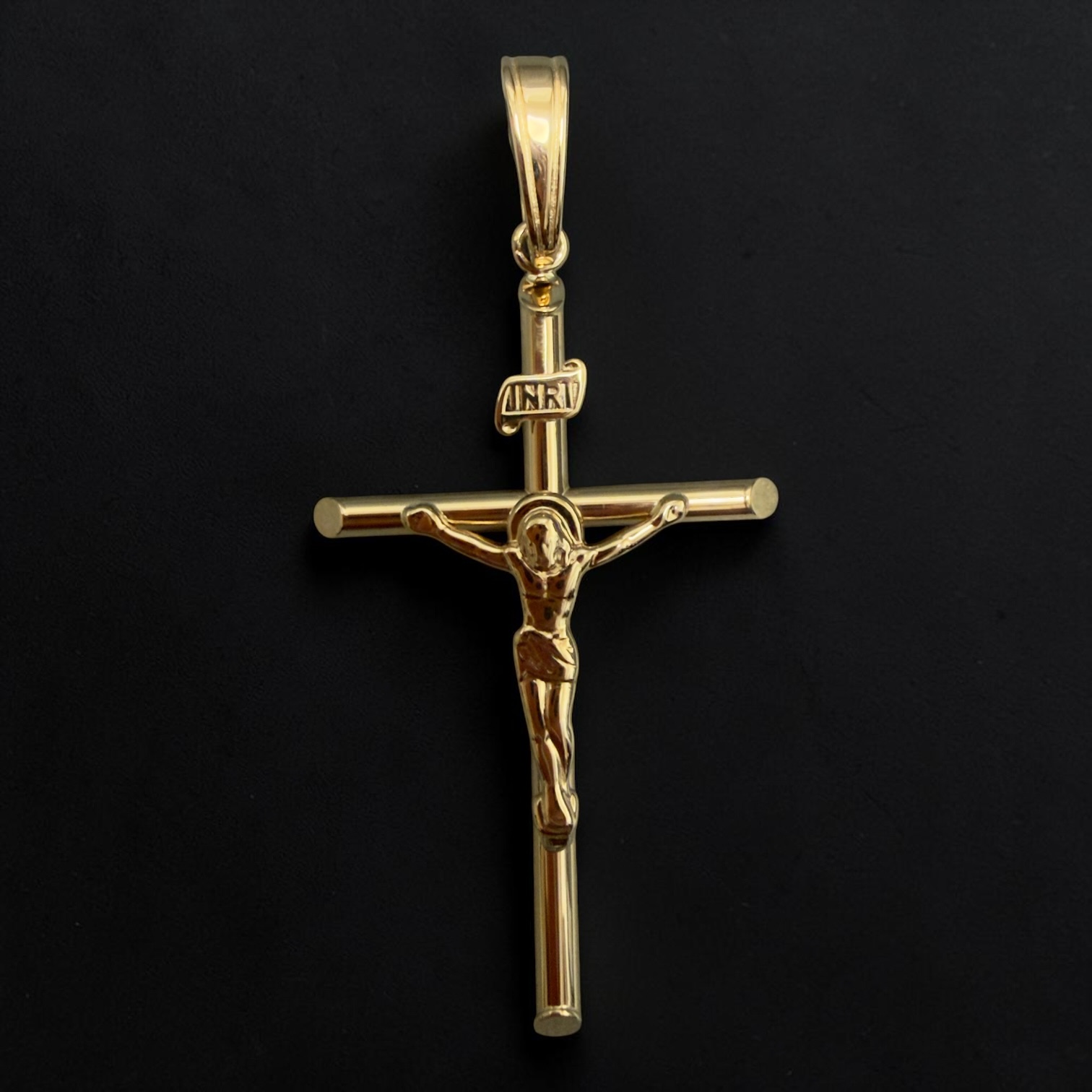
Another example is the AL3 Pendant K18 2.65g Cross INRI, a K18 pendant of 2.65 g.
Why it matters: for plain gold pieces — chains, bangles, plain bands — Japanese shops quote and buy by gram weight as the base, then adjust for cut, design, brand and condition. Compare gram weights alongside purity, construction, stones and condition; weight alone does not establish value. The R7813 Ring K18/PT900 7.80g Diamond 0.172ct illustrates two measurements: the recorded piece weight of 7.80 g and the diamond weight of 0.172 ct, but that does not establish how every piece is weighed. Ask whether a stated weight includes stones or findings if the listing does not say. Weight and purity are different measures; neither a heavier nor a lighter piece necessarily contains more gold without the relevant weights and materials. Read the stamp and the listing together.
(This guide does not state any per-gram price or rate: our prices are set per piece and shown live on each product page.)
06 / 09
K18 jewelry authentication in Japan
Questions to ask when reading a listing or examining a piece; this is not a claim that Cha Jewels performs every step on every piece:
- Find and read the stamp — on the inside of a ring band, the flat tab of a necklace clasp, or an earring post S10. Expect K18 or 750 for gold; Pt850/Pt900/Pt950 for platinum S10.
- Look for the Mint hallmark — the flag and diamond S1. Present: a certified purity. Absent: not a fault, because the system is voluntary S1.
- Weigh the piece and compare with the stated weight; a gold listing with no weight is a listing to question.
- Check that the metal colour and wear are consistent with K18 — the alloy makes K18 harder than K24, so visible wear or a different colour should be discussed with a qualified professional; appearance alone does not establish purity.
- Match the paperwork — for diamonds and gemstones, a certificate where one exists (our FAQ explains when a certificate is included); for branded pieces, the brand's own markings.
- Ask. Our FAQ explains what "preloved" means, how authenticity is handled and which services (polishing, resizing, repair, certification) we offer.
Check the product listing for its hallmark and verification details, and ask us if a detail is not stated. (the wording on our Jewelry Guide).
07 / 09
Buying K18 jewelry in Japan: what to read on a listing
A good K18 listing in Japan tells you, before you ask: the stamp (K18/750 and whether a Mint mark is present), the gram weight, the length or ring size (Japanese ring sizes are in 号; the Jewelry Guide's ring-size section converts them), the clasp type, the condition (new, or preloved with its wear described), any stone weights and certificates, and — for branded pieces — the brand as marked on the piece. Our product names carry stamp, weight, size and style in that order so the grid can be scanned, and the product page carries the rest. The Shopping Guide covers ordering, payment, shipping and returns; the Wholesale page covers trade purchases (minimum 10 pieces, 5 business days, JPY or PHP, as stated there). Customers in Japan and the Philippines can reserve with layaway on the English site; the down payment and monthly amounts are quoted live by our system on each product page, never in this guide.
08 / 09
Care
K18 is harder than pure gold but still a soft metal by everyday standards. Wipe pieces after wear, store them apart so faces and settings are not scratched, keep them out of hot-spring water (sulphur), shampoo and seawater, and wash only with lukewarm water and a little neutral detergent when needed. The Jewelry Guide's care section is the full version, including platinum and pearls; this guide defers to it.
09 / 09
Where to go next
- New K18 pieces: the Fine Jewelry category. Preloved K18 and platinum: the Preloved Jewelry and Preloved Branded Jewelry categories.
- Chains: the Necklaces and Bracelets collections, and the Kihei chain listings for cuts, weaves and weight classes.
- The stamp table: Metals and stamps in the Jewelry Guide.
FAQ
What does K18 mean?
Gold that is 18 parts in 24, i.e. 75% gold, alloyed with metals such as silver, copper and palladium for hardness and colour .
Are K18, 18K, 750 and Au750 the same?
They denote the same 75% purity written in different conventions; K18 is the Japanese form, 750 the thousandths form the Japan Mint uses .
What is the Japan Mint hallmark?
A voluntary certification mark: the Japanese flag beside a diamond-shaped frame containing the purity in thousandths (750 for K18), applied by the Mint at a maker's or seller's request after testing .
Is a K18 piece without the Mint mark genuine?
It can be. The Mint system is voluntary, so many genuine pieces carry only the maker's K18 or 750 stamp; the stamp is read together with a weight check .
Why is the gram weight in every product name?
For plain gold pieces, weight is the base of how the trade in Japan values them, and it is the most comparable number between two listings of the same purity .
Is K18 or K24 better for jewelry worn daily?
K18: it is harder, so it resists scratches and deformation better than K24, which is purer but softer .
How do I check a preloved K18 piece?
Check the product listing for its hallmark and verification details, and ask us if a detail is not stated.
Sources
Not sure? Ask a person.
Send us a photo or a measurement and we will help you check the size, the length or the stamp.