Skip to content

Guide

Jewelry guide

Ring sizes, chain lengths, clasps, metals, diamonds and care. The things worth checking before you reserve, in one place.

01 / 07

Ring size

Japanese jewelers size rings in 号 (gō), from 1 up to about 28. Each size adds about a third of a millimetre to the inside diameter, and about 1 mm to the inside circumference.

This table is a guide only. The width and shape of a band, and the time of day you measure, all change how a ring fits. If you are between two sizes, message us before you reserve.

How to measure

With a strip of paper or thread

Wrap a thin strip of paper or a piece of thread around the base of the finger, snug but not tight. Mark where it overlaps, lay it flat and measure the length in millimetres. That is the inside circumference: find the closest figure in the table. Check it would still pass over the knuckle.

With a ring that already fits

Lay a ring that fits the same finger on a ruler and measure straight across the inside, edge to edge. That is the inside diameter: find the closest figure in the table.

Before you decide

  • Measure at the end of the day, when fingers are at their largest.
  • Fingers swell in the heat and shrink in the cold. Avoid measuring straight after a bath or on a cold morning.
  • Measure two or three times and go with the figure that comes up most.
Ring sizes (JCS scale)
Size (号)Inside diameter (mm)Inside circumference (mm)
113.040.8
213.3341.9
313.6642.9
414.044.0
514.3345.0
614.6646.1
715.047.1
815.3348.2
915.6649.2
1016.050.3
1116.3351.3
1216.6652.4
1317.053.4
1417.3354.5
1517.6655.5
1618.056.5
1718.3357.6
1818.6658.6
1919.059.7
2019.3360.7
2119.6661.8
2220.062.8
2320.3363.9
2420.6664.9
2521.066.0
2621.3367.0
2721.6668.1
2822.069.1

Sizes follow the JCS scale most Japanese jewelers use. Figures in millimetres.

02 / 07

Necklace length

The same chain sits differently on every neck. These are the usual names for each length, and roughly where each one falls.

Typical necklace lengths
  1. Chokerabout 35–40 cmClose around the base of the neck.
  2. Princessabout 43–48 cmOn or just below the collarbone. The length most people choose first.
  3. Matineeabout 50–60 cmBetween the collarbone and the bust.
  4. Operaabout 70–85 cmAt the bust or below it.
  5. Ropeabout 90 cm and overLong enough to wear doubled or knotted.

Typical ranges. Jewelers draw the lines a little differently, and your height and build change where a chain sits.

Not sure? Lay a necklace you already own flat, measure it end to end with the clasp, and compare.

03 / 07

Size notes

What to check for each kind of piece before you reserve.

Rings

Where we know a ring's size, the listing shows it in 号. Many rings can be resized after purchase, but whether a piece can, and by how much, depends on its design. Ask us before you reserve.

Necklaces

Where a length is given, compare it with the chart above. A chain with an adjuster or a spare ring can also be worn a little shorter.

Pendants

Check the bail, the loop the chain passes through. It has to be wide enough for the chain you plan to wear; a thick chain will not pass through a small bail.

Bracelets

Measure your wrist snugly with a strip of paper, then allow a little room. A bangle has no clasp, so it must pass over the widest part of your hand.

Anklets

Measure around the ankle where it will sit, and allow a little room.

Earrings

Pierced earrings go through the ear; clip-on earrings hold by gentle pressure and need no piercing. In Japanese listings, ピアス means pierced and イヤリング means clip-on. Check which one a piece is before you reserve.

04 / 07

Clasps

Most clasps open with a fingertip. Here are the five you will meet most often, and how each one works.

Spring ring

A small round ring with a tiny lever. Pull the lever back with a fingernail, slip the end ring in and let go: the ring closes by itself.

Lobster clasp

Shaped like a claw. Press the lever to open the gate, hook it onto the end ring, then release. Easier to hold than a spring ring.

Box clasp

A flat tongue slides into a small box until it clicks. To open, press the tongue down and pull it out. If there is a safety catch on the side, close that too.

Magnetic clasp

The two ends hold together by magnet. Bring them close and they find each other. To open, slide them apart sideways rather than pulling straight.

Hook clasp

An S- or J-shaped hook that passes through a ring. Hook and unhook it by changing the angle, never by bending the hook.

05 / 07

Metals and stamps

Every listing shows the stamp exactly as it is struck. Here is what each one means.

What K18 means

K18 is 75% gold. The remaining 25% is alloy — usually silver and copper — and it is what sets the hardness and the colour. K24 is pure gold and too soft for jewelry you actually wear. K18 is the fine-jewelry standard in Japan. In Europe the same standard is marked 750 or Au750, and in English-speaking markets 18K: K18, 750, 18K and Au750 all denote the same 75% purity. We show the stamp as it appears on the piece.

Gold content
75%
Same standard
750 / 18K / Au750
Daily wear
Suitable
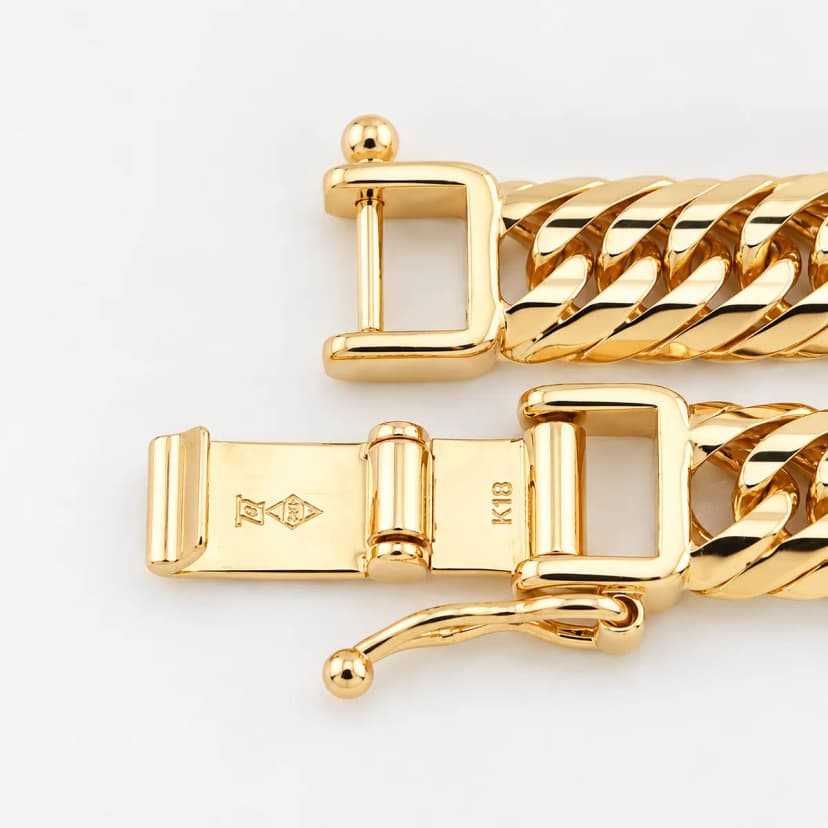
Illustration of a K18 yellow gold chain clasp, with a K18 stamp and a hallmark struck into the clasp plate.
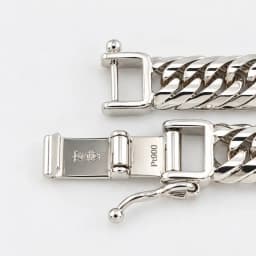
Illustration of the same style of clasp in platinum, stamped Pt900.PlatinumPlatinum is marked the same way, e.g. “Pt900”.

How to read the stamp

Gold carries a K18 or 750 stamp plus a maker's mark. Platinum is marked PT900 or PT950. The stamp sits somewhere discreet: look at the flat tab on a necklace clasp, the inside of a ring band, or the post of an earring.

Gold
K18 / 750
Platinum
PT900 / PT950
Where to look
Clasp tab, ring inside, earring post

Every stamp we list

K24
Gold
Pure gold, 24 parts in 24. Too soft for everyday jewelry.
K18
Gold
75% gold, 18 parts in 24. The fine-jewelry standard in Japan.
750
Gold
75% gold. The same purity as K18, written in thousandths.
18K
Gold
75% gold. The same purity as K18, as English-speaking markets write it.
K14
Gold
About 58% gold, 14 parts in 24. More alloy than K18, so harder.
K10
Gold
About 42% gold, 10 parts in 24.
PT1000
Platinum
Pure platinum, 1000 parts in 1000.
PT950
Platinum
95% platinum, 950 parts in 1000.
PT900
Platinum
90% platinum, 900 parts in 1000. The most common platinum for jewelry in Japan.
PT850
Platinum
85% platinum, 850 parts in 1000.
PM
Platinum
An older way of marking platinum, seen on vintage pieces. It often carries no number, so the stamp alone does not tell you the purity.
PM900
Platinum
The older platinum mark, with a number added. If you would like to know more about a particular piece, ask us.
Silver 925
Silver
92.5% silver, 925 parts in 1000: sterling silver.

A stamp records what the maker marked. Our preloved and branded pieces are hallmark checked in Japan before we list them.

06 / 07

Diamond 4C

Diamonds are described by four qualities that all start with C. Grading reports use them; here they are in plain words.

Cut

How well the stone is shaped and polished, which decides how much light it sends back. Round brilliants are graded from Excellent to Poor. The cut is what makes a diamond sparkle.

Carat

Weight, not size: one carat is 0.2 g. Two stones of the same carat can look different in size, depending on how they are cut.

Clarity

How free the stone is of tiny marks inside it (inclusions) and on its surface. The scale runs from FL, flawless under 10× magnification, through IF, VVS, VS and SI, to I, where marks are often visible to the eye.

Colour

How close the stone is to colourless, from D (colourless) to Z (light yellow or brown). The difference between neighbouring grades is very hard to see with the eye alone.

If a piece comes with a grading report, ask us and we will tell you what it says.

07 / 07

Care

Warm water, a mild soap and a soft cloth. Store pieces separately so they do not rub against each other, and keep them away from hot springs and chlorine, which discolour the metal. Pearls need wiping after every wear and restringing every few years.

Cleaning
Warm water, mild soap
Avoid
Hot springs, chlorine
Pearls
Wipe after wear, restring every few years

Not sure? Ask a person.

Send us a photo or a measurement and we will help you check the size, the length or the stamp.